
One million Chinese in Africa, a great chance to develop the Continent
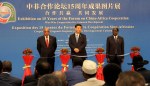
(PHOTO: GOVERNMENTZA / FLICKR.COM)
Chinese engagement in Africa do not seem to slow down. It gives rise to those who claim that China is planning to move to Africa hundreds of millions of poor farmers to solve the problems of overpopulation and pollution. Most of Chinese in Africa today are temporary migrants, employees of Chinese state-owned and private companies. However, more and more independent migrants have landed in Africa in search of new economic and social opportunities. The connections with the fatherland allow the creations of hundreds of small shops through which they sell a wide range of low-cost products. Demographic developments in African countries and China are moving in opposite directions. The need for labor-intensive Chinese companies to relocate their production facilities may be answered in Africa.
The number of Chinese immigrants in Africa has exceeded one million units in 2012, a figure probably underrated, equal to a seven-fold increase compared to 160 thousand units in 1996.
Accessing primary natural and agricultural resources, entering new markets and transferring surplus, making military deals and sell weapons, securing diplomatic allies and moving poor farmers and workers are just some of the reasons for a phenomenon that appears unstoppable. The reasons may not necessarily be coordinated by a single orchestrator.
Most of Chinese in Africa today are temporary migrants, employees of Chinese state-owned and private companies, but more and more independent migrants are arriving in Africa in search of new economic and social opportunities.
The modern Chinese migrations in Africa have their roots in the international relations that the President Mao Zedong wanted to establish in the late 50s. During this period, China’s policy in Africa was purely political, that is, it aimed to promote anti-colonial and post-colonial solidarity with the newly independent African countries. Today’s Chinese migratory trends towards Africa aims almost exclusively to the search for profit.
The new Chinese immigrants establish their activities in the retail or wholesale trade of goods produced in China without entering the wage labor market purely for practical reasons such as lack of fluency in local languages, low capital required to start up and connections with Chinese manufactures.
The growth of Chinese business communities in Africa indeed creates labor demand that calls for and encourages further migration from China facilitated by the social and economic networks to which each Chinese merchant belongs, that is, the recruitment of other Chinese citizens taken among relatives and trusted family friends in China.
Many of the independent migrants enter African territory illegally by taking advantage of the corruption and ineffectiveness of the agencies responsible for border control and immigration, reasons for which it is hard to obtain accurate data on the Chinese presence in Africa and that obviously leads to deem that the million Chinese in Africa is actually an underestimated figure.
Demographic developments in African countries and China are moving in opposite directions.
Africa is a considerably young continent, with about half of the population under the age of 20. The age distribution of the African population follows a pyramidal form typical of the initial phase of an industrialization process.
The demographic trend of China today is very different from those of the African countries. Only about 20% of the Chinese population is under the age of 19, and the large segment between 25 and 54 years of age reflects the rapid growth of the population in the second half of the last century.
The decline in births is attributable to the well-known reasons of industrial countries such as education, birth control and urbanization. China’s family planning policy, which limited most urban households to one child, then accelerated the demographic change.
The African workforce will increase dramatically over the next 20 years, as those who are 19 years old will gradually join the workforce. This huge wave of new minds and bodies is both an opportunity and a challenge for the black continent.
The need for labor-intensive Chinese companies to relocate or build their production facilities overseas to face the wage increases that are reaching the average levels of industrialized countries may find satisfaction in Africa.
Conversely, the African institutions should formulate and execute targeted development policy to incentivize Chinese firms in Africa to curb the migration flow from China and then employ and improve the skills of the local workforce.
China is playing a significant role in the development of African countries and its influence on the continent will continue to grow alongside the increase in trade flows and economic aid.
By using a magnifying glass rather than a telescope, the phenomenon of Chinese migration in Africa appears today differently. It is more a story of individuals and families than of large state-owned enterprises and humanitarian organizations controlled by the Chinese government, as it is happening in other Western countries, a view that does not fit the stereotypes of American and European media.
The large number of Chinese migrants in Africa will continue to accompany the intense flow of goods and capital from China by requiring migrants to settle permanently on the continent.
References: China Daily, 2017; Daily Mail, 2008; Financial Times, 2017; FOCAC, 2016; Howard French, 2015; SAIIA, 2009; The Brookings Institution, 2016; The Economist, 2014; United Nations Population Division, accessed 2018; World Development, 2016
 Zhu+Rich Sagl